
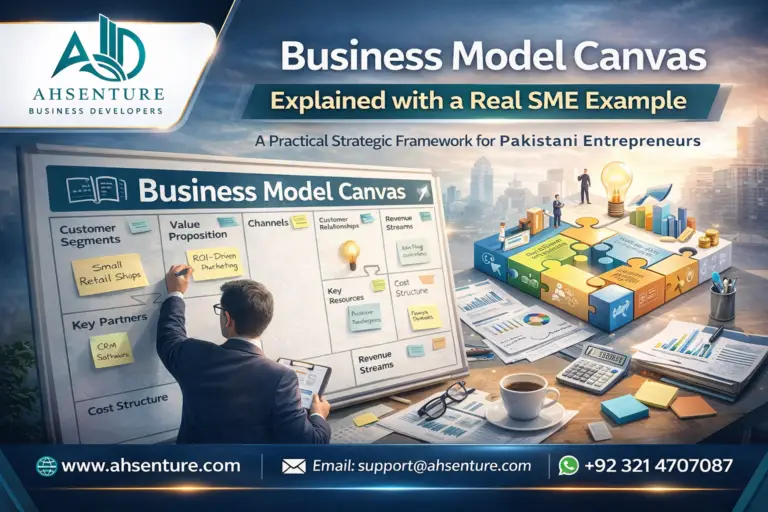
A Practical Strategic Framework for Pakistani Entrepreneurs
Many small and medium enterprises (SMEs) in Pakistan start with a product, a service, or a skill, but without a clearly defined business model.
They know what they are selling.
They are less clear about how the business actually creates, delivers, and captures value. This lack of structural clarity often leads to pricing confusion, operational inefficiency, weak differentiation, and ultimately unsustainable growth.
The Business Model Canvas (BMC) is one of the most powerful tools available to entrepreneurs for designing, analyzing, and improving their business model in a structured manner. This article explains the Business Model Canvas in depth and demonstrates how it works using a real SME example relevant to the Pakistani market.
What Is the Business Model Canvas?
The Business Model Canvas is a strategic management framework that visually maps the core components of a business on a single page. It helps entrepreneurs answer nine fundamental questions about their enterprise:
- Who are our customers?
- What value do we offer them?
- How do we deliver that value?
- How do we generate revenue?
- What resources are essential?
- What activities must we perform?
- Who are our key partners?
- What are our cost drivers?
- How do all these elements align strategically?
Unlike a traditional business plan, the Business Model Canvas forces clarity and simplicity. It highlights relationships between revenue, cost, operations, and customer value. For SMEs, this clarity is critical.
The 9 Components of the Business Model Canvas
Let us briefly explain each component before moving to the real example.
1. Customer Segments
Every business must define precisely whom it serves. Attempting to serve “everyone” leads to weak positioning. Customer segments may be categorized by:
- Demographics
- Industry
- Income level
- Geography
- Behavioral patterns
Clear segmentation enables targeted marketing and value delivery.
2. Value Proposition
This is the core of the business model.
It answers:
Why should customers choose you over alternatives?
A strong value proposition solves a specific problem, reduces pain, or creates measurable benefit. Without differentiation, competition shifts toward price — reducing profitability.
3. Channels
Channels describe how the business reaches customers. These may include:
- Physical outlets
- Social media
- E-commerce platforms
- Sales teams
- Distribution networks
Channel efficiency directly impacts customer acquisition cost.
4. Customer Relationships
This defines how the business interacts with customers.
Is it:
- Personal and relationship-based?
- Automated and digital?
- Subscription-based?
- Transactional?
Customer retention strategy significantly affects long-term sustainability.
5. Revenue Streams
Revenue must be clearly structured. Common SME revenue models include:
- Direct sales
- Subscription
- Commission
- Licensing
- Bundled pricing
Many SMEs fail because they do not align pricing with value delivery.
6. Key Resources
These are the critical assets required for operation. They may include:
- Skilled staff
- Technology
- Intellectual property
- Equipment
- Brand reputation
Identifying key resources prevents inefficient investment.
7. Key Activities
These are the most important operational tasks required to deliver the value proposition. For example:
- Production
- Marketing
- Service delivery
- Logistics
- Quality control
Operational focus must align with strategic objectives.
8. Key Partnerships
Strategic partners reduce risk and increase capability. Partnerships may include:
- Suppliers
- Distributors
- Technology providers
- Financial institutions
- Marketing collaborators
In capital-constrained environments, partnerships enable asset-light growth.
9. Cost Structure
Understanding cost drivers is essential for margin control. Costs typically include:
- Fixed costs (rent, salaries)
- Variable costs (raw materials, commissions)
- Marketing expenditure
- Technology investment
Without cost clarity, profitability becomes unpredictable.
Real SME Example: A Digital Marketing Agency in Lahore
Let us apply the Business Model Canvas to a hypothetical but realistic SME.
Business Type:
A mid-sized digital marketing agency serving small retail businesses in Lahore.
Customer Segments
- Small retail brands
- Local e-commerce sellers
- Boutique clothing stores
- Restaurants targeting online growth
Clearly defined as SMEs needing digital presence.
Value Proposition
- Affordable, performance-based digital marketing
- Local market expertise
- Measurable ROI tracking
- Social media growth + paid ad management
The agency differentiates through ROI transparency.
Channels
- LinkedIn and Facebook lead generation
- Referrals
- Website inquiries
- Networking events
Customer Relationships
- Dedicated account manager
- Monthly performance reports
- Ongoing retainer contracts
This encourages recurring revenue.
Revenue Streams
- Monthly retainers
- Paid ad management commissions
- Website development add-ons
- Branding packages
Diversified revenue reduces dependency risk.
Key Resources
- Skilled digital marketers
- Graphic designers
- CRM system
- Reporting software
Human capital and technology drive value.
Key Activities
- Campaign planning
- Ad optimization
- Content creation
- Performance analytics
These must be standardized for scalability.
Key Partnerships
- Freelance content creators
- Web developers
- Media buying platforms
- Payment gateways
Partnerships reduce fixed cost burden.
Cost Structure
- Staff salaries
- Advertising tools subscription
- Office rent
- Marketing costs
Maintaining healthy margins requires careful cost monitoring.
Why the Business Model Canvas Matters for Pakistani SMEs
Many SMEs operate reactively.
They focus on:
- Daily sales
- Immediate cash flow
- Short-term opportunities
But without a defined business model, long-term sustainability becomes fragile.
The Business Model Canvas forces strategic alignment between:
- Customer value
- Revenue logic
- Operational structure
- Cost efficiency
This clarity improves:
- Investor readiness
- Loan applications
- Internal decision-making
- Scalability potential
Common Mistakes When Using the Business Model Canvas
- Treating it as a one-time academic exercise
- Copying generic templates
- Ignoring cost structure realism
- Failing to update it as the market evolves
The Business Model Canvas should be reviewed periodically as the business grows.
How Ahsenture Business Developers Helps SMEs Design Strong Business Models
At Ahsenture Business Developers (SMC Pvt Ltd), we use structured strategic frameworks, including the Business Model Canvas, to help SMEs:
- Clarify their value proposition
- Identify profit leakage
- Optimize cost structures
- Improve revenue logic
- Align operations with strategy
- Prepare for scalable growth
A well-designed business model reduces uncertainty and increases strategic confidence. If you are building or restructuring your SME and need clarity on how your business truly creates and captures value, our advisory team can guide you through a structured model development process.
You may connect with us at:
🌐 www.ahsenture.com
📧 [email protected]
Final Reflection
A business idea is not a business model. Sustainable enterprises are built on structured alignment between customers, value, revenue, operations, and cost. The Business Model Canvas offers a simple yet powerful tool to design that alignment. For SMEs operating in competitive and volatile markets, clarity is not optional.
It is strategic survival.
Frequently Asked Questions
What is a business model canvas?
A strategic tool that visually maps how a business creates, delivers, and captures value.
Why is the business model canvas important for SMEs?
It helps clarify revenue streams, cost structure, value proposition, and operational alignment.
Can Pakistani SMEs use the business model canvas effectively?
Yes. It is especially useful for startups and small businesses seeking structured growth.